
Adrian's Photo Stream
Welcome to my photo stream! This is where I choose to share a little more insight about a particular photo beyond what can be found by viewing the photo in the online gallery. You might see new posts as often as weekly. On the other end, there will be gaps when I am not sharing here, yet the plan is for more frequent updates than the longer journal posts. Each post allows for comments; feel free to connect on here in the same way you might leave a comment on social media. At times I may share details relating to the gear or processing involved. The goal is simply to provide a window into how, what, and why I took and processed the photo.
Not Searching, But Finding
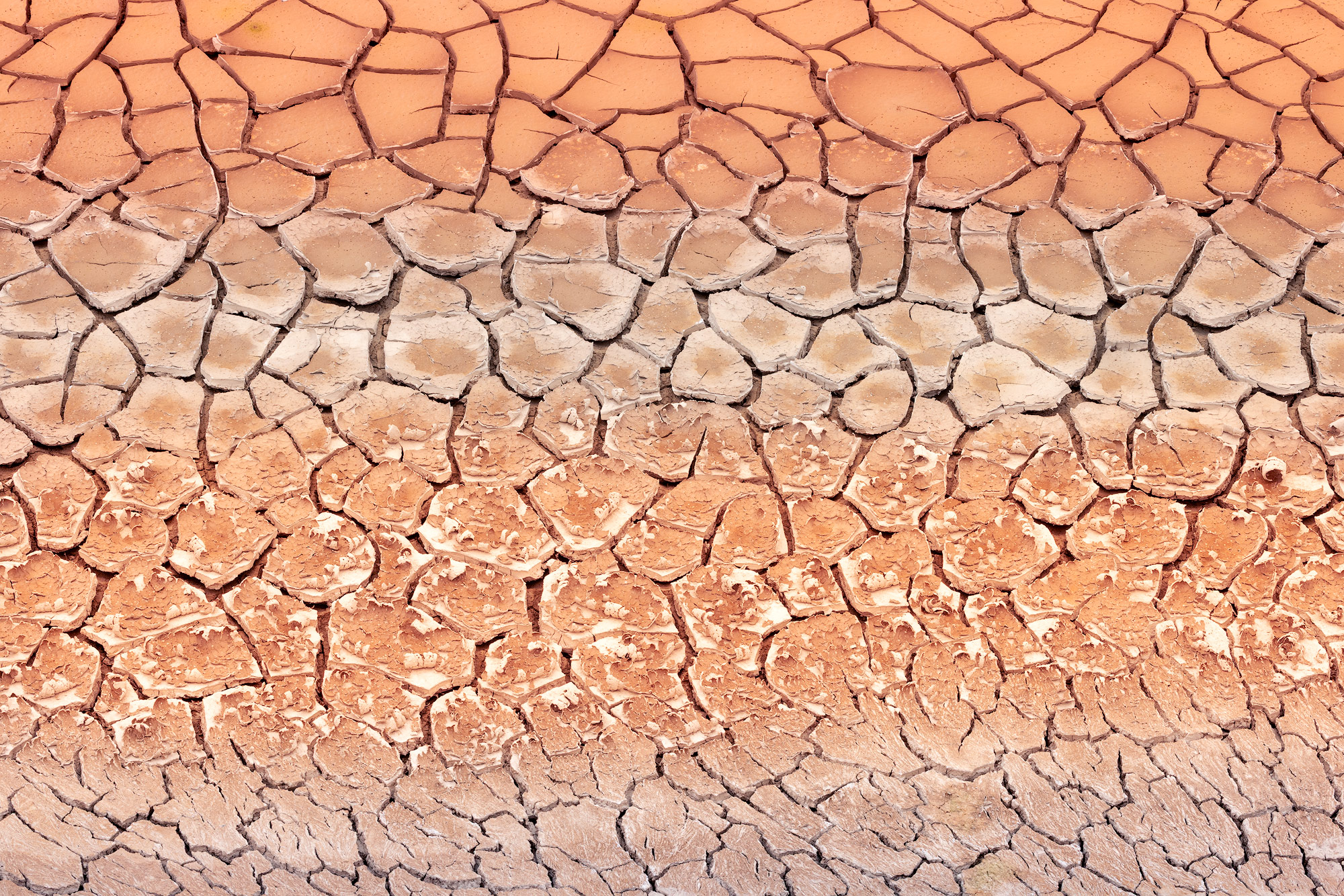
Four distinct crack patterns on the desert floor
With all the driving I do, it's common to stop alongside a road for a break. These range from well-traveled paved roads to rocky, less frequented ones. The stops are usually for grabbing snacks or finding an appropriate bio break spot. What I have found over the years is that these breaks sometimes result in the camera coming out unexpectedly. As was the case here just outside of Death Valley. I could see some cracks from the road, but it wouldn't have been something I would have stopped for. Yet the act of slowing down for another reason altogether resulted in seeing what lay not far from the edge of the road. The break took a few minutes longer due to this "distraction," yet I would say it was time well spent. I am not sure another car passed during the time I was there. I could hear the quiet linger in the air. A less traveled road for this stop.
Camera and Processing
- Canon R5, RF100-500mm F4.5-7.1 L IS USM @100mm, f/22, 1/5 second, ISO 160
- Processing mainly involved working with the colors to bring them a little more life and a minor crop for cleaner edges.
Looking For Food
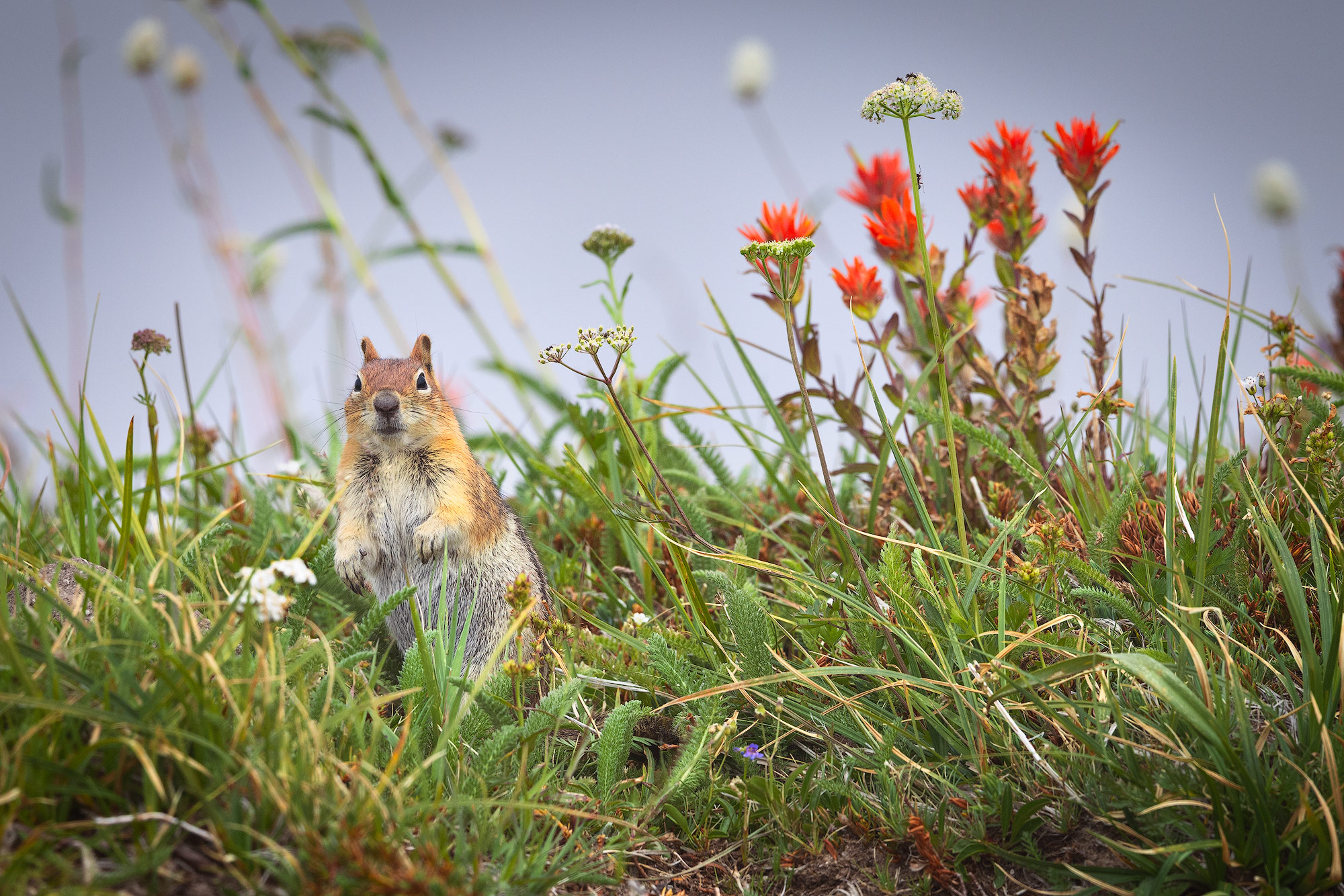
A chipmunk out in the wilderness looking for a snack from me. Or anyone willing to give one.
While hiking with my daughter this summer, we stopped for lunch at our turnaround point. When we were sitting on the edge of a rock wall tent shelter, this one chipmunk kept on playing hide and seek with us. More seeking than hiding, as it was eagerly hopeful to get some of our lunch. I have no doubt this one got plenty of "leftovers" from others that might choose to camp or pitstop here. I do my best to avoid feeding wildlife, yet accidents happen. In this case, there weren't more than a few inconsequential crumbs, much to its frustration.
After we finished eating and put the food away, it lost interest in us. No surprise there. I watched it move into the grass and flowers nearby as it was scurrying about. I almost left behind my long heavy telephoto lens. This was not a short or flat hike. I am glad I made use of it for this photo and a few others.
Camera and Processing:
- Canon R5, RF100-500mm F4.5-7.1 L IS USM @ 345mm, f/7.1, 1/1250 second, ISO 400
- I ended up cropping a fair bit from the original frame to bring the viewer closer to the chipmunk and Indian paintbrush. Along with other minor adjustments in color and luminosity.
The Four Ghosts
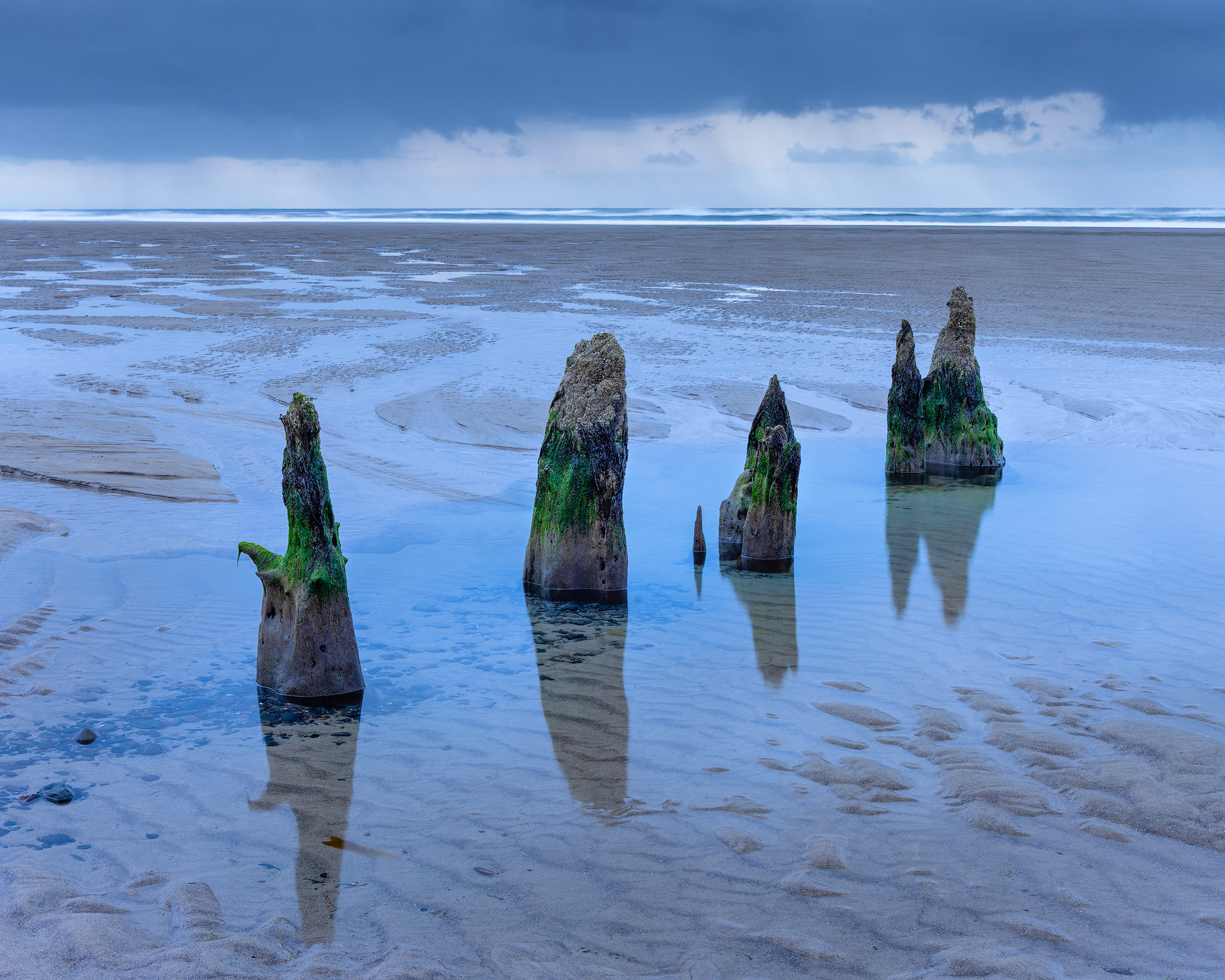
Remaining tree trunks from a Ghost Forest on the Oregon Coast
These four stumps stand the test of time with an estimated age of 2,000 years. Oregon has multiple ghost forests along the coast that were created in some cases due to different events. This is the Neskowin Ghost Forest that came from a forest of Sitka spruce, which is believed to have been created from a slow-moving sand dune nearby thousands of years ago that buried the trees. Not until the late 1990s, after a big winter storm, were some of the remaining stumps visible from all the sand that washed away. Now each year it changes after winter, where only a few might be found to as many as 30 on a good year. I am sure it's only a matter of time before Mother Nature takes all these stumps out to the ocean with no remnants left.
While on a trip to Alaska this summer, I was standing on a large dune near an ocean inlet. Here it was pointed out by my brother (an environmental science professor) that the trees below were slowly being covered as the dune moved. You could clearly see multiple trees in the process of getting buried. It was interesting to see the early stages of something I photographed that same year, thousands of years after it occurred. As humans, we truly are a blip on the radar of time.
Camera and Processing:
- Canon R5, RF24-105mm F4 L IS USM, f/16, 2.5 seconds, ISO 100
- Kept with the cool stormy and overcast morning that I felt on this day. Some work to ensure the viewer can see clearly into the reflecting tree stump shadows
The Forest Scorpion

A scorpion in the lush Pacific Northwest forest of the Central Cascades of Oregon. Known as the Northwest Forest Scorpion that prefers to live in the damp forest climate. Not the dry desert we usually associate with scorpions.
This is a pretty good story, at least I think so. Let me start this by saying I knew Oregon had scorpions. Surprisingly, for all my time in the outdoors, this was my first time seeing one. Maybe they are giving Sasquatch a run for their money as the world's best at hide-and-seek. Who knows.
It was a family camping trip in the Willamette National Forest of the Central Cascades, and on the last morning, as we were cleaning up from breakfast, my daughter's friend went back over to their tent to get something. I heard the words, "there is a scorpion in our tent". Not screaming in panic. Calmly, as in that seems odd. Of course I hear that, and the logic in my head says there isn't a scorpion in there. I walk over and look down to see a live scorpion was indeed on the mattress pad.
Two questions immediately came to mind. One, how did it get in there? Two, what do we do with it? And I guess three, is it venomous? None of us had encountered one in our home state. Sure, I have seen them in places like Death Valley, yet it never crossed my mind camping in a dense forest filled with evergreens and moss. My daughter's friend said she woke up itching what she thought were multiple spider bites. We eventually concluded those were stings from the scorpion. This particular type normally wants to hide from humans under logs, rocks, and leaves or play dead. They normally only sting when they are trapped, which was the case here. Fortunately, the stings aren't any more medically of a concern than the sting of a bee.
Some in our group wanted it dead because of fear it was venomous, and it might get someone else. This was before we were back in cell range to fully determine what kind of scorpion and what likely happened. That was not my plan. Just because something can hurt us doesn't mean it needs to die. Sure, sometimes that might be the case, but not here. No one was threatened. Since we didn't know, I put the scorpion in a mason jar. And just down the road from the campground walked into the forest to let it go. This is when I was able to take the photo. It didn't want to hang around long. I took a small number of frames, and then it was gone into the leaf litter of the forest floor. I am sure much happier than being stuck all night in the tent.
I titled this photo "No One Like You", if you know why, bonus points for you!
Camera and Processing:
- Canon R5, EF100mm f/2.8L Macro IS USM, f/4.5, 1/60 second, ISO 800
- Cropped in some from the larger frame, minor color updates, along with a couple adjustments relating to highlights and shadows for the scorpion to stand out more in the dark damp forest
Get My Good Side

A young calf moose known as a calf decides to look my way in Alaska
If you have been to Alaska, you likely know how abundant wildlife is. It's hard to go for a week-long trip and not have some encounter with wildlife if you are spending your time outdoors. You might get stuck waiting on a trail for a bear, as was the case just before we arrived. It required my brother to ask another family member to pick us up from the airport because they got "bear blocked" by a sow and cubs and thus were running behind.
Moose are plentiful in Alaska and I have seen one or more on every trip. This time we had a few encounters from the trail to the backyard. In this case we came home to find a mom and calf munching on the moose-moss. If you know what book this is from, bonus points. We enjoyed watching them, from a distance of course. All wildlife has varying distances you want to keep and while moose don't look intimidating casually grazing on vegetation, they can be deadly if you get too close. For a brief moment, this calf happened to look my way just as I had the camera ready before catching up with mom to continue the evening snacking.
Camera and Processing:
- Canon R5, RF100-500mm F4.5-7.1 L IS USM at 500mm, f/7.1, 1/160 sec, ISO 800 (hand held)
- Processing was mainly in LR with some in PS, minor changes to bring out the nice soft light on the moose, including minimizing the bright sky, which was distracting
Freezing Fog

A small forest of trees after a recent forest fire, looking like they are flocked after multiple days of freezing fog.
You know those locations with real potential you pass over and over, for years? Usually the same thought pops up, "I should probably stop", yet the block of metal on wheels keeps barreling down the road. That was the case here. I realized when I took this photo it had been 21 years since the first time I passed this lake and forest. After the first time, I am not sure, but at least 20+ more times. Part of the challenge is where it's located. The speed limit is 70 mph, and there's no easy place to pull over. By the time you pass it, the process can be almost 20 min to get back around to it.
The sad yet fascinating part to me is that every other time I passed this spot before this trip, the trees were alive and green. It literally took the trees being burned to a crisp from a wildfire with multiple days of freezing fog coating them in white, before I said this is the time I am stopping! Like prior times, I whizzed past it shortly before sunset. The light was fading. I made the loop detour back to the spot and took a small number of photos, this being one of them. I am glad I did. Even if I were to come across this area with the uncommon freezing fog again, this spot has completely changed in the less than two years since I took this photo. Many of the dead trees have fallen over. Unless you have a compelling reason to keep going, find time to eventually stop.
Camera and Processing:
- Canon R5, EF100-400mm f/4.5-5.6L IS II USM at 182mm, f/14, 1 second, ISO 400
- Processing including some luminosity masking for mid tones and darks, multiple layers for color adjustments both globally and localized. I wanted the cooler feel, which is how I experienced it and saw that evening. Followed by going with more of a pano look.
Abstract!

Stripes of paint and rust work together over many years to create this abstract art on a metal surface.
I don't remember exactly how it went, but apparently my family does. I can get pretty excited when I see something that really interests me photographically. We stopped at a spot for lunch that had old machinery on it. I see this large metal area that looks really intriguing, and I say something to the effect, "ooohhh, abstract," yet according to their version, it was "ooohhh ABSTRACT!" because of how loud I said it. It's immortalized on a mug I received as a present last year, along with other quotes I have said over the years they found humorous enough to write down. At any rate, I finished my meal before anyone, which was a surprise to no one. I grabbed my gear and had a little fun creating this photo before we left.
Camera and processing:
- Canon R5, EF100-400mm f/4.5-5.6L IS II USM at 248mm, f/20, .4 seconds, ISO 200
- Processing was all in ACR, minimal work, no masking, simply some global light and color adjustments
The White Dots

A close-up view along the shores of the Olympic Peninsula, Washington
I had thought about making a photo like this for a long time. Anytime I would come across this subject it would slip my mind, until this time. I am not going to say what it is. Good chance you can guess, and if not then enjoy the mystery. We don't have a lot of that in our lives these days. What I will say is that I honestly had no idea what this would look like up this close. Nature is fascinating!
Camera and Processing:
- Canon R5, EF100mm f/2.8L Macro IS USM, f/9, .5 seconds, ISO 400
- Processing included focus bracketing for DOF, adjusting the highlights/shadows, adjusting for color to showcase it more like I saw it and felt at the time, then finally cropping in a little tighter for the pattern to have a better flow.
Expect The Unexpected

A stand of tree trunks remains from a fire and glows as the sun rises in Sawtooth National Forest, Idaho
This was a location we had not planned to visit during the workshop, but we scouted it out just in case. Mother Nature had unexpected plans for us. Not typical for the area, we experienced dense fog almost all mornings. While this can be exciting for the mood, mystery, and general atmosphere it offers, we wanted to give this spot a try after photographing the thick fog the prior morning. We made a game-time decision to go to this spot, which is a little higher in elevation than the densely fogged-in lakes. The morning started with light fog that burned off rather quickly. The whole group had a wonderful morning discovering and creating among the burned landscape. I was able to create a few photos myself during the few visits to this spot, including the one here as the morning light hit these burned-up ponderosa tree trunks. The unexpected was better than anything we could have expected that morning.
Camera and Processing:
- Canon R5, EF100-400mm f/4.5-5.6L IS II USM at 400mm, f/14, .3 seconds, ISO 125
- Minimal processing was performed, mainly bringing out the warmth of the trunks and blues in the shaded background.